Most have studied history.
Melvin Macklin has lived it.
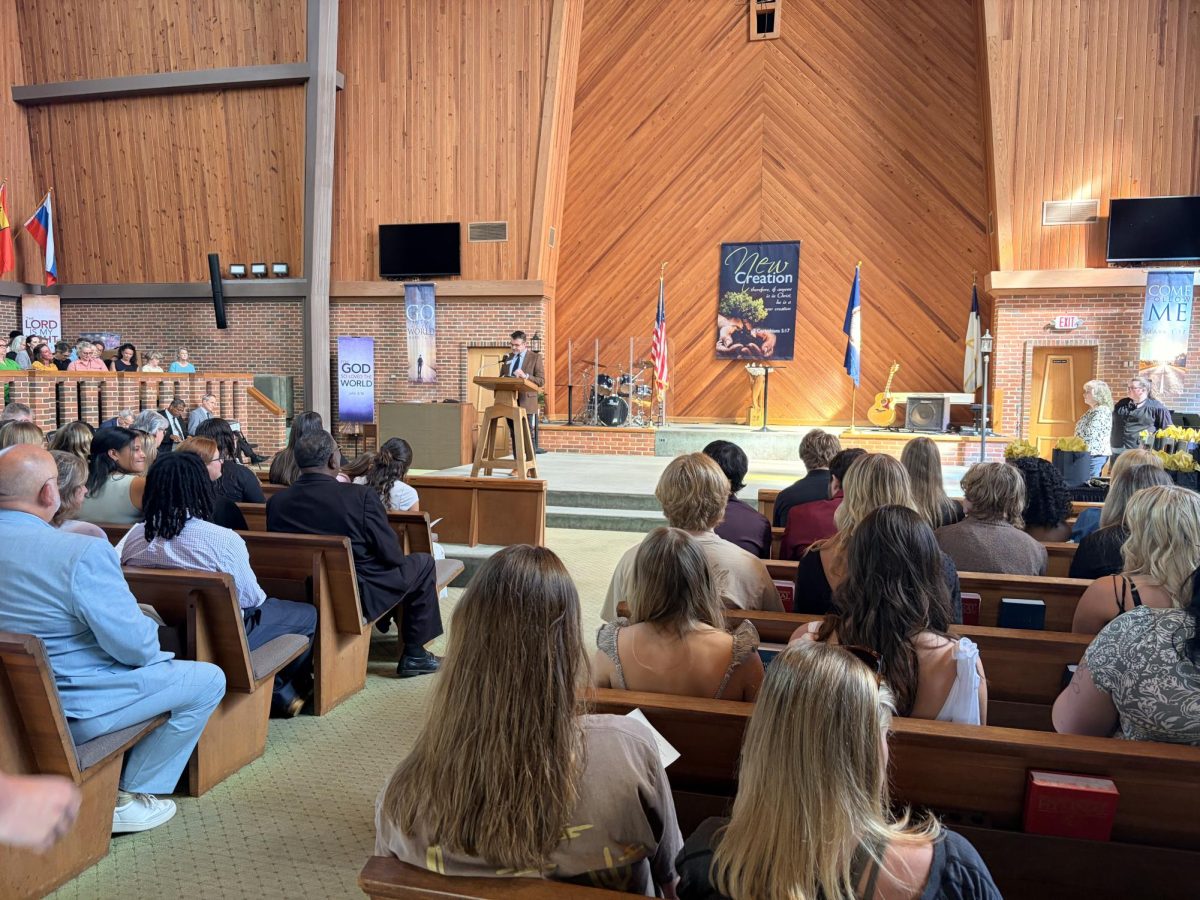
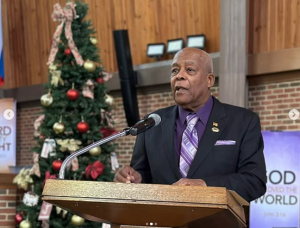
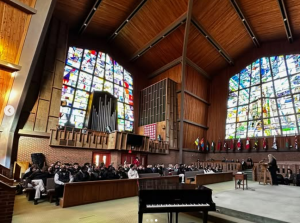
Macklin was only a child at the start of the Civil Rights Movement, and on Jan. 18, 62 years after Martin Luther King Jr.’s “I Have a Dream” speech, the emeritus professor spoke amongst students, faculty, and staff in Vaughn Chapel in honor of MLK Day.
There he shared his accounts of discrimination, education, and social change throughout the unprecedented era of American history.
Macklin has taught at Ferrum since 2008. However, his career did not begin as a college professor, nor at Ferrum.
It began at a preschool.
“Well, they didn’t call it preschool back then,” began Macklin jokingly. “They called it Head Start. I did that for about two days.”
He also served in the United States Army as a staff sergeant.
Macklin later attended Southern Illinois University, majoring in Spanish and minoring in English. At Texas A&M, Prairieview, Macklin achieved his master’s degree and then continued to earn his PhD from the University of Texas, Dallas.
While working towards his education himself, Macklin taught at a local community college in Texas, as well as ESL to bordering Hispanic students.
He noted the discrimination he faced as a student of color throughout his graduate education. He is determined this prejudice will never see the light of day in a classroom of Macklin’s.
“As far as my teaching and interacting with my students go, the one, most important lesson I learned from my experiences with biased professors at The University of Texas is to always be fair, treat every student with respect, and to give each one the same opportunities,” explained Macklin. “As a college professor, this has always been my utmost goal.”
While a defining moment in his life, graduate school was not Macklin’s first account of discrimination. In fact, his first experience was at the age of 10.
“Well, we were walking uptown in my little hometown of Carbondale, IL,” Macklin recalled. “All of a sudden, my grandmother just reached and grabbed me, really snatching me off of the sidewalk and into the curb. And she said, ‘What is wrong with you? Didn’t you see that white woman coming? You know better than to block a white woman’s path!'”
To 10-year-old Melvin Macklin, this was a new concept, and one that led him to realize that he was living in an era of segregation.
“Then I began to notice other events and signs that signaled that my world was, indeed, not normal,” said Macklin.
He began to notice that he only went to school with those who looked the same as him, and that bathrooms, water fountains, waiting rooms, and even buses were separated by the color of skin.
This concept, known as segregation, continued until the passing of the Civil Rights Act of 1964.
Macklin also reported events such as being pulled over by police officers, despite no reasonable cause, and movie theaters closing their doors for good before allowing those of different races to enter.
“Oddly enough, though these events were dehumanizing and humiliating, somehow, I personally never felt humiliated, nor did I ever feel embarrassed about being black,” Macklin said. “Also, oddly enough, after all these early incidences, the fact that I was a so-called second-class citizen still hadn’t fully sunk in. To this day, I still do not know. I only know that I had truly not comprehended the concept of a disenfranchised race or that I belonged to it.”
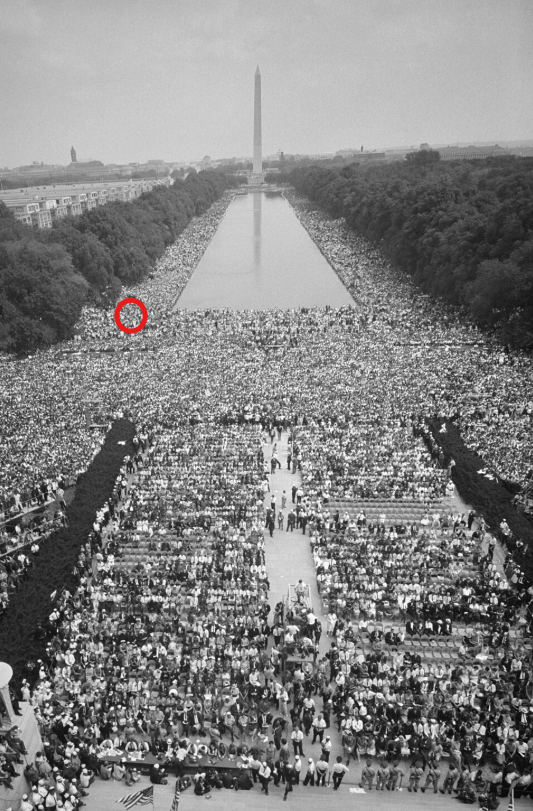
According to Macklin, the harsh reality did not even hit his comprehension while attending The March on Washington, a peaceful protest led by King that was organized to address the ongoing racial, social, and economic injustices against those in the African American community.
“I was walking across the campus of Southern Illinois University on November 22, 1963, on my way to class,” he recalled. “The announcement went out across the university’s loudspeakers that President John F. Kennedy had been shot. This news hit me, as the saying goes, like a ton of bricks, because I knew that Kennedy had spent his entire political career actively engaged in fighting for the rights of people of color. And I had heard elderly blacks say repeatedly, ‘Every time somebody stands up for blacks, he gets killed.’ It was this assassination that rocked me to the core.”
Macklin remarked that he will forever remember that day.
“It was the only time that I had ever felt utter despair,” Macklin noted. “I knew now what Dr. King’s civil rights movement was all about. By the time Dr. King was gunned down at the Lorraine Hotel in Memphis, TN, in April of 1968, the totality of what the civil rights campaign truly meant had been firmly cemented into my mind. These two courageous leaders, Dr. King and John F. Kennedy, died because they desired equality for all.”
Suddenly, The March on Washington and the Civil Rights Movement became real to Macklin.
“I remember arriving in Washington to a massive crowd,” he said, “the likes of which I had never seen in my life. I felt an excitement that was palpable.”
Joan Baez, Sidney Poiter, Harry Belafonte, Charlton Heston, and Marian Anderson were just some of the many celebrities present.
“When Mahalia Jackson began to sing, and Maya Angelou began reading her poetry, I felt that something monumental was happening–that this day would have a profound effect on humanity, and me.”
According to Macklin, he realized that King was speaking to him.
“When Dr. King spoke of his vision of children and young people everywhere, black and white, having the same opportunities to become whatever they wanted to become, I thought, ‘He’s speaking to me,'” offered Macklin. “I, too, had a dream. I was 18 years old and wanted to be a teacher.”
To Macklin, King was an inspiration. He accredits his success, in part, to King’s efforts.
“His speech spurred me to strive for the prize,” explained Macklin. “Decades later, after battling enormous struggles of my own, including having to contend with biased professors, I marched across the stage at the University of Texas at Dallas and received my PhD. As I did so, I thanked God; I thanked my mother; and I thanked Martin Luther King for having paved the way for me and countless other blacks and minorities to achieve their educational goals.”
Now, Macklin himself serves as an inspiration to others, including Professor Kathrine Grimes.
“He’s lived through stuff that 90% of Americans haven’t, and he was old enough to remember what 80% of Americans weren’t old enough to remember,” said Grimes. “In a way, I feel that we get to live vicariously through him.”
In addition, Macklin strives to give each and every student the opportunity to succeed.
“I learned the evils of discrimination and how it can damage one’s belief in himself,” said Macklin. “This, in turn, can lead to a myriad of problems. Low self-esteem is devastating for students. Therefore, I have always endeavored to make sure I never do or say anything that would hinder their progress.”
Junior Bryan Rosado appreciates having professors such as Macklin, who, to him, embody the concept of living history.
“I love having professors that have actually lived through that because we can hear their side of history and how it affected them,” he remarked. “I feel like we can somewhat relate it to what’s happening with ICE right now.”
Macklin, too, believes that King’s dream has yet to be fulfilled completely, having spoken of American xenophobia, genocides seen across the world, and frequent assassinations.
“I believe only when each and every citizen taps into his dream and cast off apathy will we be able to see the promised land that Dr. King envisioned,” Macklin spoke. “Only then will folks be judged not by the color of their skin, but by the content of their character.”
Living as an example, Macklin aims to carry King’s dream out in his own life, as well as encourage others to do the same.
“Living through the 1960s and its trials taught me to always try to hold everyone in high regard, maintain a positive attitude, and look upon each individual as being equal. This is most essential in navigating our lives,” he concluded.